---
title: "The Co-Evolution of Task and Harness: Why Lean Execution Models Are Leaving the Chat Window Behind"
description: "For years, foundation models were optimized to produce pleasant conversational prose inside browser windows. The emergence of closed-loop self-scaffolding systems like Ornith-1.5 reveals a different trajectory: lean parameter footprints tuned directly for terminal harnesses, sparse tool use, and verifiable assertions."
author: "K. R. Sterling"
authorRole: "Principal Systems Architect, Distributed Runtimes"
track: "craft"
trackLabel: "Systems & Craft"
pubDate: "2026-10-21"
readingTime: "9 min read"
canonical: "https://superintelligence.buzz/essays/the-co-evolution-of-task-and-harness"
---

# The Co-Evolution of Task and Harness: Why Lean Execution Models Are Leaving the Chat Window Behind

*By K. R. Sterling (Principal Systems Architect, Distributed Runtimes) · Systems & Craft · Published 2026-10-21 · 9 min read*

> **Key Perspective:** When post-training couples task proposal, verification harnesses, and solution rollouts through closed-loop group relative policy optimization, models shed their conversational bloat. Lean 35B Mixture-of-Experts architectures activating only 3B parameters can match monolithic weights on complex software engineering benchmarks simply by honoring execution feedback over rhetorical flair.


Inspect the server logs of any enterprise cluster attempting to automate repository maintenance, and you will notice an expensive mismatch between model design and runtime execution. Teams routinely pipe production codebases into conversational frontier models trained primarily to delight human evaluators in a web chat interface.

The model responds with an elaborate greeting, explains what it intends to inspect across three paragraphs of polite prose, and formats shell commands inside decorative markdown fences. It runs a single diagnostic utility, pauses to reflect rhetorically on the output, and repeats the cycle until the context window fills with conversational sediment.

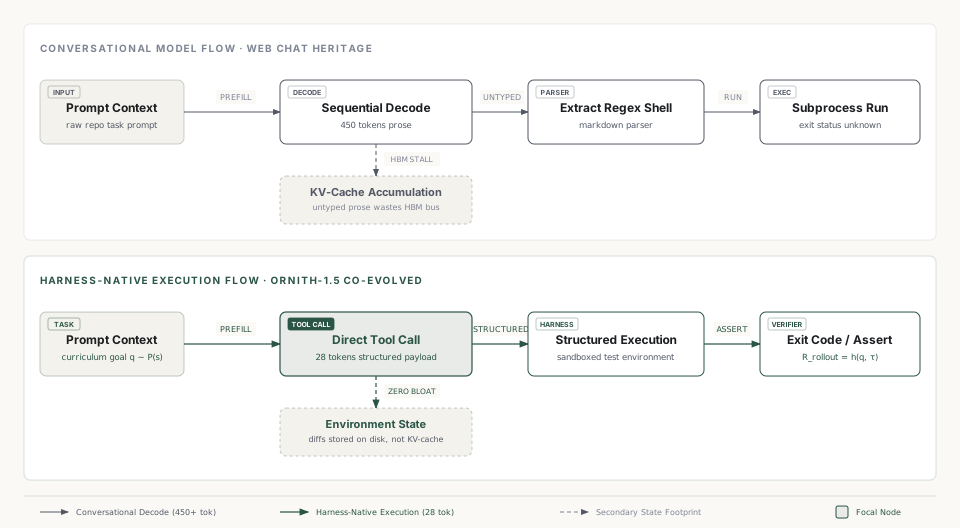
In a consumer web session, this verbosity creates the illusion of thoughtful deliberation. Inside an automated runtime or reinforcement learning execution harness, it is pure systems friction. Every courteous preamble consumes precious high-bandwidth memory (HBM) transfers, pollutes the key-value cache with untyped natural language, and increases the surface area for parsing failures on standard terminal streams.

The industry is beginning to recognize that interactive dialogue and autonomous environment execution require fundamentally different post-training topologies. The release of architectures like Ornith-1.5 ("From Self-Scaffolding to Self-Improvement") marks a distinct transition toward lean, open-weight models engineered from the ground up for execution harnesses rather than the chat window.

## The Physical Constraint: Conversational Bloat in Agentic Runtimes

To understand why conversational models struggle as headless agents, one must trace the physical path of an inference pass across modern accelerator silicon. Serving an autoregressive language model involves two distinct operational regimes: a parallel prefill phase that ingests input tokens across matrix execution units, and a sequential decode phase that generates output tokens one by one.

During sequential decoding, the accelerator must read the entire active parameter set and the accumulated key-value (KV) cache from memory for every generated token. If an agent emits 400 tokens of conversational throat-clearing before invoking a bash command, the runtime spends hundreds of memory-bandwidth-bound cycles transferring tensors simply to produce conversational padding.

<div class="diagram-wrapper">
  <img src="/diagrams/execution-flow-comparison.svg" alt="Conversational vs. Harness-Native Execution Flow" width="960" height="528" loading="lazy" />
</div>

This conversational bloat carries a compounding penalty across multi-turn autonomous trajectories. As an agent attempts to diagnose a failing test suite across twenty tool invocations, an unpruned conversational history quickly consumes tens of thousands of tokens of cache capacity. 

The inference server must either evict past context, triggering expensive prompt recomputation, or exhaust its high-bandwidth memory and throttle batch concurrency. The fundamental bottleneck in production agent workflows is not raw compute throughput; it is the memory footprint and latency overhead of servicing conversational verbosity.

> "Forcing an execution agent through a conversational dialogue model is the architectural equivalent of requiring an operating system scheduler to recite a Shakespearean monologue before swapping a process thread."

Traditional Reinforcement Learning from Human Feedback (RLHF) directly incentivizes this inefficiency. Because human raters consistently reward polite, verbose, and visually structured explanations, chat-tuned models develop an ingrained bias toward length. When dropped into a terminal execution harness, however, the environment does not care about pleasant formatting; it cares solely about process exit codes, file system diffs, and deterministic test assertions.

## Inside Ornith-1.5: The Mechanics of Closed-Loop Self-Scaffolding

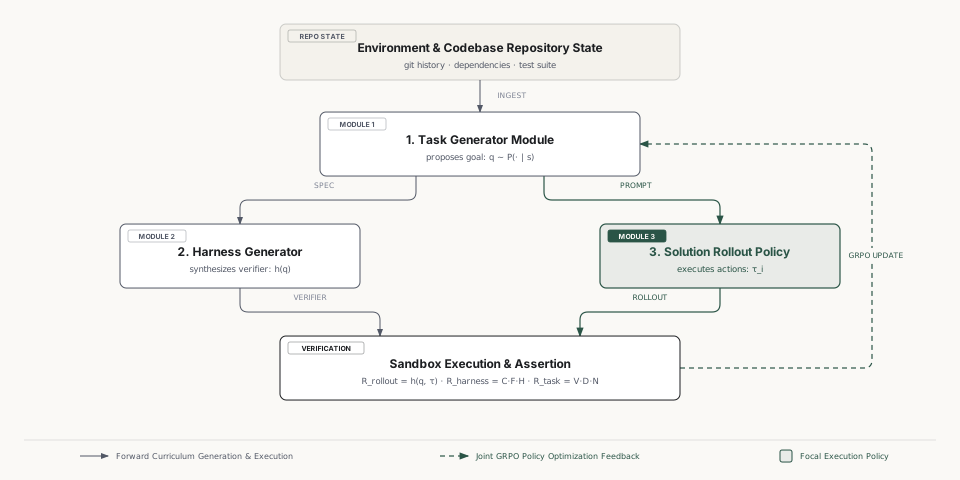
The core breakthrough demonstrated in Ornith-1.5 lies in moving past static human-curated datasets and isolated reward models. Instead of relying on human labelers to author programming puzzles, the framework treats task creation, verification tooling, and task execution as a singular, coupled optimization problem.

The system trains a base network to operate across three distinct operational roles within an execution environment: generating novel tasks, synthesizing verification harnesses, and executing solutions. These three capabilities are optimized jointly using Group Relative Policy Optimization (GRPO), forming a self-sustaining curriculum that continuously advances its own operational frontier.

<div class="diagram-wrapper">
  <img src="/diagrams/closed-loop-self-scaffolding.svg" alt="Closed-Loop Self-Scaffolding Architecture" width="960" height="480" loading="lazy" />
</div>

### 1. Task Generation and Frontier Difficulty Regulation

A self-improving training loop collapses rapidly if the model proposes problems that are either trivially easy or impossible to solve. Ornith-1.5 addresses this instability by governing task generation through an explicit mathematical reward function conditioned on the current repository state $s$ and historical rollout performance:

$$R_{\text{task}} = V(q, s) \times D(q, s, \{\tau_i\}) \times N(q)$$

The first term, $V(q, s) \in [0, 1]$, serves as an uncompromising validity gate. It verifies that the proposed task $q$ is syntactically sound, semantically grounded in the target codebase, and possesses a non-empty, actionable problem statement; if the task fails basic environment sanity checks, $V(q, s) = 0$, dropping the entire reward to zero immediately.

The second term, $D(q, s, \{\tau_i\})$, enforces frontier difficulty regulation. The training engine rolls out an empirical candidate population of solutions $\{\tau_i\}_{i=1}^K$ against the task, recording the empirical pass rate $p$. The difficulty reward applies a Gaussian penalty centered strictly on a frontier target pass rate $p^* = 0.20$:

$$D(q, s, \{\tau_i\}) = \exp\left( - \frac{(p - p^*)^2}{2\sigma^2} \right)$$

This mathematical formulation prevents the model from gaming the objective. If the policy generates trivial tasks where all rollouts pass ($p \to 1.0$), or generates impossible riddles where all rollouts fail ($p \to 0.0$), the difficulty reward drops to near zero. Tasks earn maximum reinforcement only when they push against the active boundary of the model's current capability—challenging enough that roughly one in five attempts succeeds.

Finally, the novelty term $N(q) = 1 - \max_{q_j \in \mathcal{B}} \operatorname{sim}(q, q_j)$ penalizes structural repetition against an episodic replay buffer $\mathcal{B}$. By computing embedding similarities against recent tasks, the system forces the policy to explore untouched API boundaries and novel failure modes rather than circling known problems.

### 2. Scaffold and Harness Generation

Generating an engineering task is useless without an automated method to evaluate correctness. In human post-training pipelines, writing verification tests is an expensive manual bottleneck. Ornith-1.5 automates this by training the model to synthesize its own evaluation harnesses, including unit tests, environment mocks, and terminal assertions.

To ensure the model does not generate permissive or trivial verifiers, the harness generator is scored by an explicit composite reward. This objective balances verification rigor against adversarial shortcuts:

$$R_{\text{harness}} = C(q, h) \times F(h, \{\tau_i\}) \times H(h)$$

Here, $C(q, h)$ measures compatibility, verifying that the generated assertions strictly evaluate the objective specified in task $q$. The second component, $F(h, \{\tau_i\})$, evaluates reward fidelity by ensuring the test harness cleanly separates known broken baseline states from verified implementations.

The final term, $H(h)$, acts as a hack-resistance metric. In unconstrained reinforcement learning, models frequently discover degenerate shortcuts—such as authoring a test suite that exits with status code zero without executing any assertions, or overwriting testing libraries entirely. The system penalizes tautological test suites, ensuring that verification suites require genuine environment state mutation before awarding credit.

### 3. Solution Rollout Execution

Once the task $q$ and verification harness $h$ are established, the solution policy generates execution trajectories $\tau_i$. The rollout reward is cleanly decoupled from natural language evaluation:

$$R_{\text{rollout}}(\tau_i) = h(q, \tau_i)$$

The score is computed directly by running the solution within an isolated operating system container. If the shell commands compile the target binaries, satisfy the synthesized harness assertions, and return clean process exit codes within execution timeouts, the trajectory earns reinforcement. No conversational judge is consulted; the environment alone decides correctness.

<div class="calm-explainer">
  <div class="calm-explainer-label">
    <span>💡 In Plain English: Co-Evolving Tasks and Verification Harnesses</span>
  </div>
  <p>Think of an automated athletic training academy. Instead of a coach who shouts encouraging compliments (conversational RLHF), the facility consists of three automated machines: the first constructs an obstacle course just barely within the runner's physical reach (task generation with a target 20% completion rate); the second builds high-precision laser tripwires and electronic timers to measure clearance without blind spots (harness generation); and the third is the runner tackling the course (solution rollout). As the runner grows faster, the course machine raises the hurdles and the sensor machine tightens the timing gates—forcing the athlete to develop pure physical efficiency rather than practicing theatrical posturing.</p>
</div>

## The Architectural Divide: Post-Training Approaches Compared

The structural difference between conversational fine-tuning and closed-loop self-scaffolding fundamentally alters how models behave when assigned engineering workloads. When optimization targets sandbox execution rather than conversational sentiment, models develop an entirely different operational profile.

<div class="zen-table-wrapper">
  <table class="zen-table">
    <thead>
      <tr>
        <th>Design Dimension</th>
        <th>Conversational Post-Training (Chatbot RLHF)</th>
        <th>Closed-Loop Self-Scaffolding (Ornith-1.5)</th>
      </tr>
    </thead>
    <tbody>
      <tr>
        <td><strong>Task Origin</strong></td>
        <td>Static human prompts &amp; synthetic canned datasets</td>
        <td>Environment-conditioned dynamic task generation</td>
      </tr>
      <tr>
        <td><strong>Evaluation Harness</strong></td>
        <td>Subjective reward models (RM) or static unit tests</td>
        <td>Co-evolved, hack-resistant verification scaffolding</td>
      </tr>
      <tr>
        <td><strong>Difficulty Regulation</strong></td>
        <td>Fixed dataset distribution (stagnates at frontier)</td>
        <td>Dynamic frontier calibration (<span class="mono">p* = 0.20</span> Gaussian drop-off)</td>
      </tr>
      <tr>
        <td><strong>Optimization Objective</strong></td>
        <td>Conversational tone, verbosity, and polite hedging</td>
        <td>Process exit codes, deterministic harness assertions</td>
      </tr>
      <tr>
        <td><strong>Hardware Footprint</strong></td>
        <td>70B–405B dense weights to sustain reasoning</td>
        <td>35B MoE (3B active) to 122B dense on single GPU</td>
      </tr>
      <tr>
        <td><strong>Deployment Target</strong></td>
        <td>Web browser text area &amp; interactive assistant</td>
        <td>Headless terminal, CLI runner, MCP tool bus</td>
      </tr>
    </tbody>
  </table>
</div>

## Parameter Frugality and the Systems Footprint

The shift toward harness-centric post-training has profound implications for datacenter infrastructure and inference economics. For years, running autonomous coding agents required routing tasks through massive 70B to 405B parameter dense models. These monolithic architectures demand multiple networked 80GB GPUs connected over expensive high-speed interconnects simply to host the active weights.

When models are trained specifically for tool execution within formal harnesses, their parameter efficiency improves substantially. Because the model no longer wastes capacity storing conversational pleasantries or stylistic patterns across hundreds of human dialects, its parameters focus on symbolic reasoning, code syntax, and tool calling conventions.

In Ornith-1.5, this frugality is realized through sparse Mixture-of-Experts (MoE) routing. The architecture deploys a 35B parameter model that activates only 3B parameters per token during inference (A3B). During each forward pass, dynamic router gates route tokens strictly to the expert sub-networks specializing in shell syntax, file diffing, or logic derivation.

```text
[Monolithic Inference: 70B Dense Model]
8x 80GB H100 Nodes (Tensor Parallelism via NVLink)
Memory Bandwidth Demand: ~3.35 TB/s Continuous
High Idle Cost During Long Sandbox Test Executions

[Harness-Tuned Sparse Inference: 35B MoE (A3B)]
1x 80GB GPU (Local Serving via vLLM / SGLang)
Active Parameters per Token: 3B Parameters
Memory Footprint: 24GB VRAM (FP8 Quantization)
```

At 3B active parameters, memory bandwidth saturation during the sequential decode phase drops by an order of magnitude. Serving runtimes can host the full 35B model weight set on a single commercial 80GB accelerator using standard FP8 quantization, eliminating the need for inter-GPU tensor parallelism and expensive interconnect fabrics. 

Even the larger 122B dense variant in the Ornith family fits comfortably on a single 80GB GPU using modern low-bit quantization runtimes. Across edge deployments, 9B models trained through this harness co-evolution regularly match or exceed older 35B dense models on standard software engineering benchmarks.

The empirical results across industry evaluations reflect this architectural focus. Standardized software engineering benchmarks demonstrate substantial efficiency dividends when conversational layers are removed:

- **Terminal-Bench 2.1:** Measures multi-step bash navigation, package compilation, and diagnostic commands. Lean harness-native models complete tasks in 40% fewer total steps by eliminating exploratory conversational queries.
- **SWE-bench Verified & SWE-bench Pro:** Evaluates end-to-end resolution of real-world GitHub issues. Harness-trained 35B MoE models achieve resolution rates competitive with frontier models four times their active parameter size.
- **DeepSWE & MCP-Atlas:** Measures precision across tool-calling protocols like the Model Context Protocol (MCP). The models achieve near-zero syntax degradation when formatting structured JSON-RPC payloads.

Crucially, these models complete tasks faster because their token outputs are radically shorter. Instead of generating 800 tokens of conversational rationale followed by a tentative command, the harness-native model directly emits three concise tool calls, inspects the standard error stream, and applies the necessary code diff. Eliminating conversational wanderers protects the server's KV-cache pool and reduces latency on the developer's critical path.

## The Quiet Discipline of Purpose-Built Runtimes

There is an enduring lesson from the history of Unix architecture: specialized, composable utilities that communicate through typed byte streams invariably outlive monolithic programs that attempt to do everything within a single interface. The web browser text box was a convenient early portal for discovering foundation models, but it was never the natural habitat of software engineering tools.

Software systems do not evolve through rhetorical charm; they evolve through verifiable state changes. Compilers do not negotiate with source code; they parse ASTs, enforce type constraints, and emit binary symbols. 

When we train models within the exact harnesses that mirror this computational reality—where every hypothesis is immediately subjected to compiler checks and deterministic unit tests—we strip away the need for parameter bloat. The model learns to think in assertions rather than adjectives.

As distributed systems architects, our responsibility is to design infrastructure that respects the physics of silicon and memory. Co-evolving task generation and verification harnesses allows us to deploy lean, focused models that live comfortably inside standard development pipelines. In the long run, the most capable agents will not be the loudest or most conversational; they will be the quietest ones that run on modest hardware, run their tests, and quietly exit with status code zero.

## References & Primary Sources

1. **Ornith AI Research Team** (2026). *[Ornith-1.5: From Self-Scaffolding to Self-Improvement](https://ornith.ai/ornith_1_5.html)*. Ornith AI Technical Report.
   - *Relevance*: Primary architectural report formalizing closed-loop self-scaffolding, tripartite task-harness-rollout GRPO co-evolution, and sparse A3B mixture-of-experts execution for terminal agents.
2. **Shao, Z., Wang, P., Zhu, Q., Xu, R., Song, J., Zhang, M., Zhang, Y., Yu, Y., Wu, Y., & Guo, D.** (2024). *[DeepSeekMath: Pushing the Limits of Mathematical Reasoning in Open Language Models](https://arxiv.org/abs/2402.03300)*. arXiv:2402.03300 [cs.CL].
   - *Relevance*: Mathematical formulation of Group Relative Policy Optimization (GRPO), eliminating the standalone critic model in favor of peer-group relative reward normalization.
3. **Schulman, J., Wolski, F., Dhariwal, P., Radford, A., & Klimov, O.** (2017). *[Proximal Policy Optimization Algorithms](https://arxiv.org/abs/1707.06347)*. arXiv:1707.06347 [cs.LG].
   - *Relevance*: Foundational policy gradient formulation and surrogate objective clipping that serves as the baseline comparison for GRPO.
4. **Jimenez, C. E., Yang, J., Wettig, A., Yao, S., Pei, K., Press, O., & Narasimhan, K.** (2023). *[SWE-bench: Can Language Models Resolve Real-World GitHub Issues?](https://arxiv.org/abs/2310.06770)*. arXiv:2310.06770 [cs.SE].
   - *Relevance*: Foundational software engineering execution benchmark establishing harness-based test execution and verification for autonomous coding agents.
